There is a headline that keeps coming up in conversations with spirits brands trying to make sense of Gen Z alcohol trends before committing to a U.S. market strategy.
"Gen Z has stopped drinking."
It usually comes with concern, sometimes panic, and often a sense that the category itself is changing in ways that are difficult to interpret. For brands already navigating the complexity of the three-tier distribution system, a generational pullback from alcohol feels like yet another obstacle standing between them and commercial success.
But when you spend enough time looking at what is actually happening, both on the consumer side and inside the U.S. market structure, that headline starts to fall apart.
Gen Z hasn't stopped drinking. They've changed the rules around when, why, and what they drink. And for spirits brands that understand that distinction, the opportunity is larger than most realize.
The "Generation Sensible" Still Drinks — Just Differently
The abstinence narrative is misleading, and the data makes that clear. While Gallup's August 2025 poll found that only 54% of Americans reported consuming alcohol — the lowest in the poll's 90-year history — the EY Consumer Beverage Survey fielded in late 2025 revealed that 80% of Gen Z drinks alcoholic beverages at least every two weeks. That figure exceeds the overall drinking-age population average of 65%.
What is happening is not abstinence. It is moderation with intentionality. U.S. per capita alcohol consumption fell roughly 10% between 2021 and 2024, with UBS documenting a further 4.4% drop in 2025. But the way Gen Z is moderating has a specific shape. Industry observers describe two distinct cohorts: one that avoids alcohol entirely or keeps it rare, and another that drinks mainly for milestone occasions — birthdays, festivals, vacations — and can spend generously when they do.
As one Phoenix restaurateur told The New York Times: "What appears to be a shift toward abstinence from drinking is a shift toward more thoughtfulness on drinking." That framing captures the commercial reality far better than the headline does.
The Gen Z Alcohol Trend Everyone Focuses On — And The One They Miss
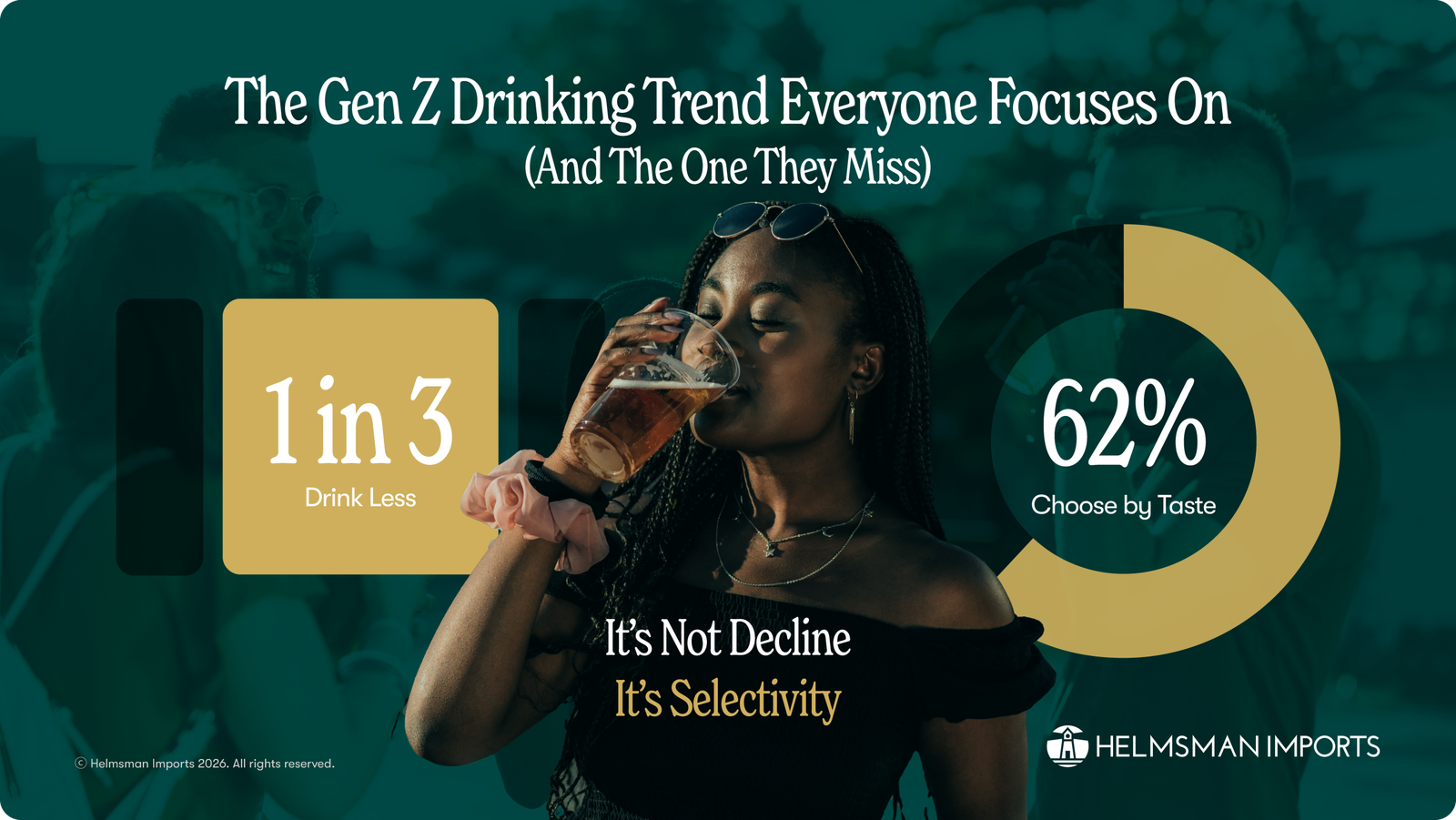
There is a stat that tends to dominate the conversation. Roughly one in three Gen Z consumers report drinking less alcohol compared to previous years. On its own, that sounds like a decline story. Fewer occasions. Shrinking volume. A generation losing interest in the category.
But that is only one side of what is happening.
A second number is far more commercially significant: approximately 62% of Gen Z consumers identify taste as their number one driver when choosing a drink, a finding reinforced by Mintel data from ProWein 2026. That changes the conversation entirely. This is not a generation walking away from alcohol. It is a generation that has become more selective about it. And selectivity, in any category, is the foundation on which premium brands are built.
What Gen Z Drinking Habits Mean for Spirits Brands in the U.S.
One of the most common mistakes brands make when reading the Gen Z data is equating fewer drinking occasions with lower commercial opportunity. In practice, the opposite tends to be true.
Gen Z is drinking less frequently, but when they do drink, they are making more deliberate choices. That means higher expectations, but it also means a higher willingness to spend on something that genuinely meets those expectations. Volume is no longer the most important metric in this cohort. Value is.
Previous generations
Gen Z
For spirits brands — particularly premium and craft producers — this is a structural advantage. The consumer who drinks four times a year with deliberate purpose is often more commercially valuable than the one who drinks weekly out of habit, provided you can earn their trust and their choice in those four moments.
The super-premium price tier achieved +1% volume growth in 2025, bucking an overall market contraction of 4% by volume. IWSR Managing Director Marten Lodewijks framed it precisely: "Consumers are becoming more selective about where they allocate their alcohol spending, increasingly evaluating purchases based on their own price-to-quality ratio. Rather than broadly trading down, drinkers are choosing to pay more only when a product clearly justifies its price."
Taste Drives Everything — Not Health
One of the most commercially significant findings from recent research corrects a widespread assumption. Mintel data presented at ProWein 2026 found that taste (47%) and refreshment (42%) are the leading factors in Gen Z's drink choices — not health and wellness, which has dominated industry narratives for years.
What drives Gen Z drink choices
Source: Mintel / ProWein 2026. Figures are illustrative of relative ranking; exact secondary percentages estimated for display.
As Mintel principal strategist Alex Beckett stated: "The narrative around Gen Z has been overly focused on health and wellness. While that does play a role, the data shows flavour remains the primary driver."
This taste orientation explains the explosive growth of ready-to-drink cocktails — the only spirits category recording consistent year-over-year growth. DISCUS reported RTD cocktail sales volume grew 16.4% in 2025, approaching a $4 billion valuation. IWSR data shows spirits-based RTDs grew 14% in 2025, and RTD share of total U.S. beverage alcohol volume expanded from 6% in 2019 to 13% in 2025.
The bar for entry has been raised across all formats. If a product is going to be chosen, it needs to justify that choice through what is in the glass first. Complexity, balance, and distinctiveness matter more than they did before. But it does not stop there. The way a drink is served, the glassware, the visual presentation, the ritual around it — all of it has become part of the product. The experience is no longer separate from the liquid. For Gen Z, it is the liquid.
How Gen Z Discovers Spirits Today
There was a time when spirits discovery was driven primarily by in-store placement, traditional media, and on-premise trade exposure. That model still matters, but it is no longer where the category conversation begins.
Today, discovery happens on a phone screen. The EY Consumer Beverage Survey found that Gen Z shows 26% higher digital usage for beverage exploration compared to other generations, engaging through online recommendations, fitness apps, and loyalty programs. An emerging data point: 27% of U.S. consumers used AI-based beverage recommendations in 2025, with Gen Z leading adoption.
Visual appeal is not a superficial trend
Nearly half of Gen Z consumers say they are influenced by how "Instagrammable" a drink is. A bottle is no longer just packaging. It is a piece of media. Serve rituals, glassware, and presentation carry commercial weight.
The "one and done" phenomenon
Gen Z ordering a single photogenic drink, capturing the moment, then leaving has been widely reported across the on-premise channel. Each serving becomes potential earned media while compressing volume per occasion — a dynamic that transforms how on-premise ROI should be measured.
Discovery extends across categories
Gen Z gravitates toward relatively new brands that market to active, culturally relevant lifestyles rather than legacy brands trading primarily on heritage. When brands align with cultural identity, as Modelo and Corona have with Hispanic and Gen Z consumers, loyalty can be strong and durable.
Social Visibility Without Market Reality
This creates a specific situation that we see frequently with international brands entering the U.S. market.
A product builds traction online. It accumulates an audience. It generates genuine consumer interest. But when those consumers try to find it at their local retailer or on a bar menu, it simply isn't there.
This gap between social visibility and physical availability is where significant commercial potential gets lost. Social traction does not automatically translate into retail presence. The U.S. market still requires compliance, distribution alignment, importer relationships, and state-specific operational structure to convert digital attention into actual sales velocity.
A brand can be genuinely viral and still underperform commercially if it cannot navigate that transition. Understanding the consumer is one part of the equation. Converting that understanding into shelf presence, on-premise placement, and consistent market execution is another challenge entirely.
Ethics Is No Longer a Brand Layer. It Is a Brand Foundation.
Beyond product and presentation, the way Gen Z evaluates brands has shifted in ways that catch many spirits producers off guard.
The EY Consumer Beverage Survey found that 58% of U.S. consumers actively monitor drink ingredients, a behavior Gen Z over-indexes on significantly. For this generation, values are not a secondary consideration or a marketing overlay. They are embedded in the purchasing decision itself. More than half of Gen Z consumers say they would stop buying from a brand that does not align with their values.
In practice, this means consumers are examining where a product is made, how it is made, what sourcing practices look like, and whether a brand is transparent and consistent in how it communicates all of those things. This is not about messaging. It is about verification. If a brand claims something, Gen Z expects to be able to check it.
Inconsistency gets found out quickly
The producer who makes sustainability claims without substance, or who communicates one thing on social and another in trade materials, will be exposed by a generation raised with the ability to cross-reference everything in seconds.
Authenticity has become measurable
Trust is not assumed. It is earned through consistency across every channel, through genuine community engagement, through founders and teams who feel like real people rather than constructed personas. Gen Z approaches brands with baseline skepticism that only evidence erodes.
How Loyalty Works Differently Now
There is a generational contrast here that carries real strategic weight.
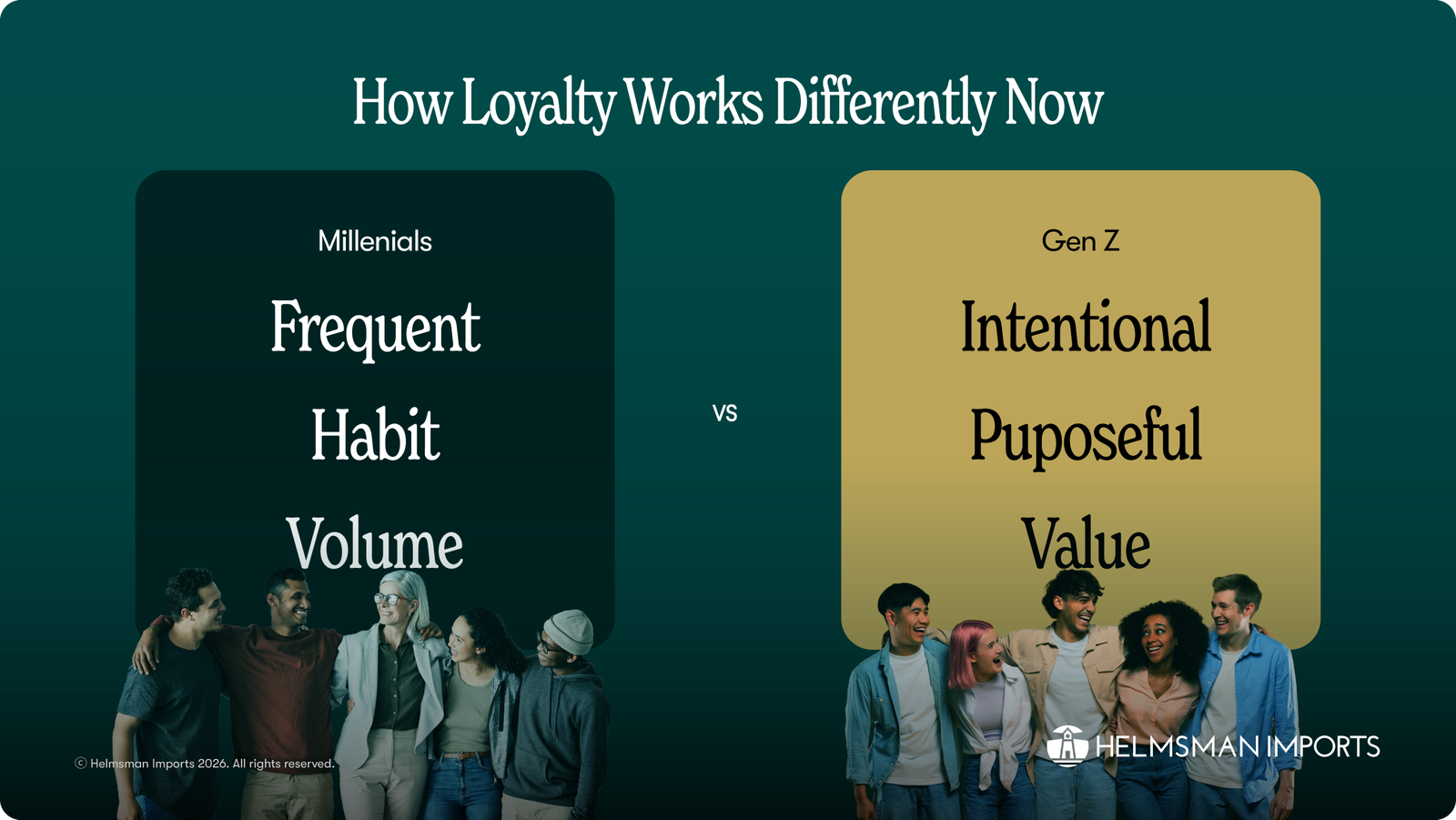
Millennials, broadly speaking, tended to stay loyal to brands until given a concrete reason to leave. Gen Z tends to withhold loyalty until given a compelling reason to stay. That distinction is subtle in description but significant in practice.
Visibility alone does not build loyalty with this generation. Consistency does. Transparency does. Reliable delivery on expectations does. Once that loyalty is established, it can be remarkably durable and influential. Gen Z consumers who genuinely believe in a brand become active advocates in ways that carry far more weight than paid media. But earning that loyalty requires more intentional work upfront, particularly in the early stages of market entry.
The Sober Curious Movement Is Being Misread
One of the most misunderstood dynamics in the current Gen Z alcohol trends conversation is the rise of the sober curious movement. It is often framed as a direct threat to spirits brands. That reading is too simple.
CivicScience data from 2025 shows 19% of drinking-age adults are "very" curious about cutting alcohol — more than double the 7% recorded in 2019. Gen Z leads participation in formalized moderation: 24% participated in Sober October 2025. A striking parallel: 53% of Americans now believe even moderate alcohol is bad for health, up from just 28% in 2018.
But the commercially vital insight is that sober curious consumers remain active in the category. CivicScience found that 27% of Sober October participants simply reduced alcohol temporarily without replacing it. And those participants proved to be 5x more likely to buy more holiday gifts — indicating they are high-spending consumers who cycle in and out of alcohol occasions rather than exiting the category permanently.
When consumers moderate and return, they come back with a different mindset. They are more selective, more open to something genuinely new, and significantly more willing to trade up. The casual, habitual purchase gets replaced by a considered one. That is precisely where well-positioned premium spirits brands have the structural advantage.
The U.S. alcohol-free drinks market surpassed $1 billion in 2025, with NA beer growing +10.8% in both dollar sales and volume. Yet NA beer still represents only 2.5% of total beer sales — suggesting most moderation-minded consumers remain primarily full-strength drinkers who occasionally choose NA options. The sober curious movement is a premiumization engine, not an exit ramp.
The Competition Has Expanded Beyond Other Bottles
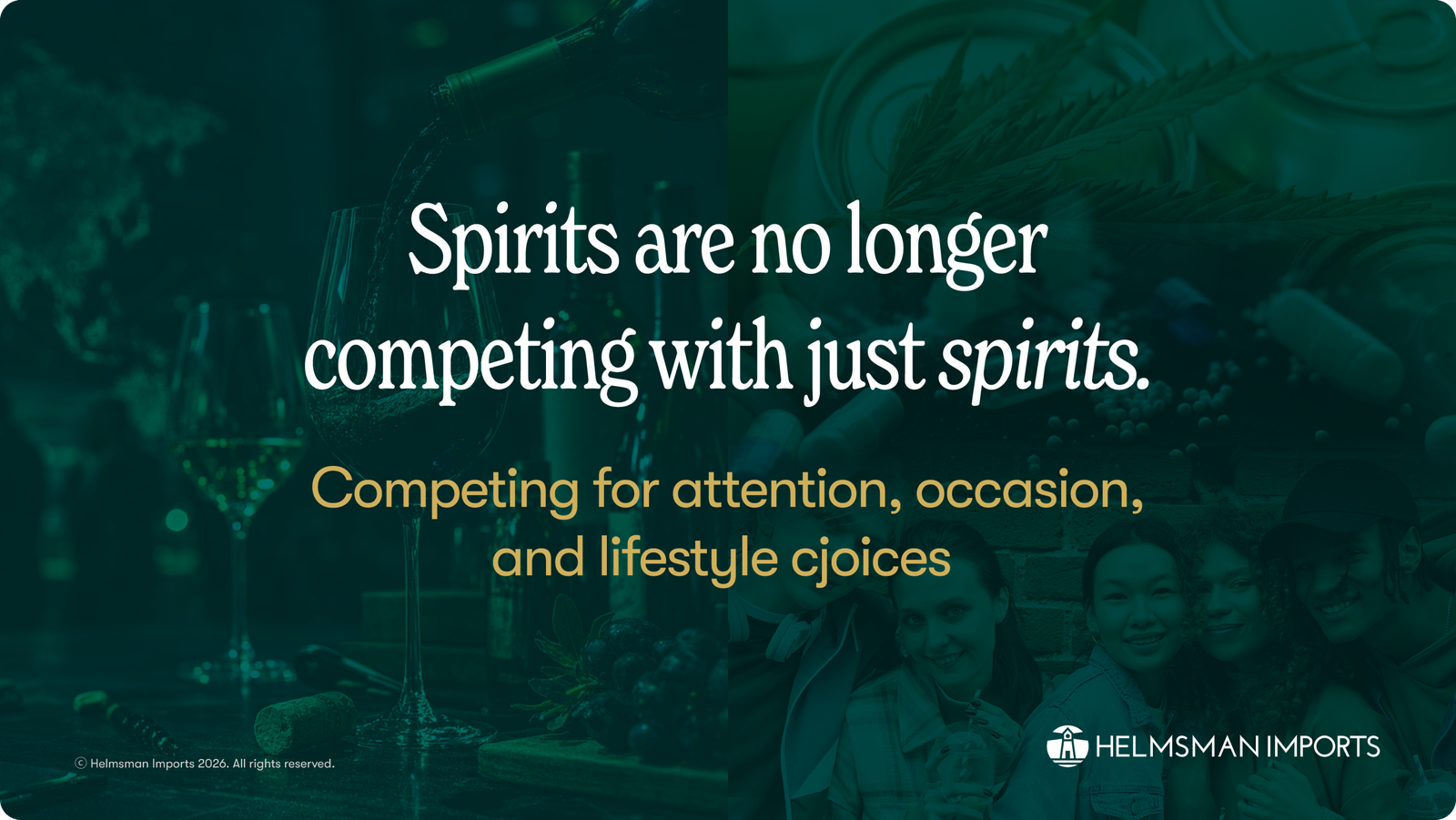
Spirits brands today are competing for attention and occasion in a broader context than they were five years ago.
Cannabis and THC
The U.S. cannabis industry has reached ~$40 billion. In Canada, a useful leading indicator, cannabis retail sales rose 11.5% even as alcohol volumes declined 3%.
GLP-1 medications
~6% of Americans now use GLP-1 drugs. KAM research found 23% of users drink less when going out. FDA approval of a Wegovy pill in late 2025 will accelerate adoption.
Non-alcoholic spirits
No-alcohol analogues grew ~9% in 2025 and are forecast to grow ~36% in volume from 2024 to 2029 — rapid growth from a small base that complements rather than cannibalizes traditional spirits.
Cultural mindfulness
The normalization of not drinking in professional and social settings has reduced the casual, low-consideration drinking occasion. What remains is increasingly intentional.
None of these forces eliminate demand. But they reduce habitual consumption — which means what remains becomes increasingly intentional. And intentional occasions consistently favor products that justify their place at the table.
What the U.S. Spirits Market Data Actually Shows
U.S. spirits market snapshot — 2025 / Q1 2026
The U.S. spirits market is in a period of recalibration, not structural decline. Volume is under pressure, but the premium tier is holding. Spirits surpassed beer in U.S. revenue share for the first time in 2025 — a dramatic reversal from 2000 when beer held 55.5% of the market and spirits just 28.7%. Brown-Forman's management noted "cautious optimism about green shoots of a recovery" in early 2026, with category performance improving from mid-single-digit declines to low-single-digit declines.
The proposed Pernod Ricard and Brown-Forman merger discussions — a potential combined entity approaching €30 billion — signals that major industry players retain deep confidence in the long-term value of the category. The market is not getting smaller in value terms. It is getting more demanding.
What Actually Works in This Environment
The spirits brands performing well with Gen Z right now share a few common characteristics that are worth understanding clearly.
They are not trying to be everywhere. They have made deliberate decisions about where to show up — which markets, which channels, which occasions — and they have committed resources accordingly. They are building relevance with a specific audience rather than chasing broad visibility. They are not waiting for the three-tier system to create demand on their behalf. They are generating genuine consumer pull and then using the distribution infrastructure to scale it.
Perhaps most importantly, they have aligned their product, their story, and their operational execution so that everything reinforces the same positioning. There is no disconnect between what the brand says online and what a consumer finds when they walk into a store or orders at a bar.
That coherence is harder to build than it sounds, especially for international producers navigating U.S. market entry for the first time. But it is the foundation on which sustainable commercial performance is built with this generation.
The U.S. spirits market is not declining. It is becoming more competitive. What the Gen Z alcohol trends data actually shows is a market that rewards precision over ubiquity — one where the brands that earn each occasion, rather than assuming habitual loyalty, will capture the most valuable and enduring part of this generation's commercial potential.
Because in the end, it has never really been about how often someone drinks. It has always been about what they reach for when they decide to.